An organization wants to elect a committee privately. Someone proposes an anonymous online poll. Another person asks how the organization will know whether each response comes from an eligible member and whether anyone voted twice.
That tension explains why secret ballot voting software deserves a more careful review than an ordinary opinion poll. An election may need to establish a person's right to participate while protecting the content of that person's choice.
Separate eligibility from ballot secrecy
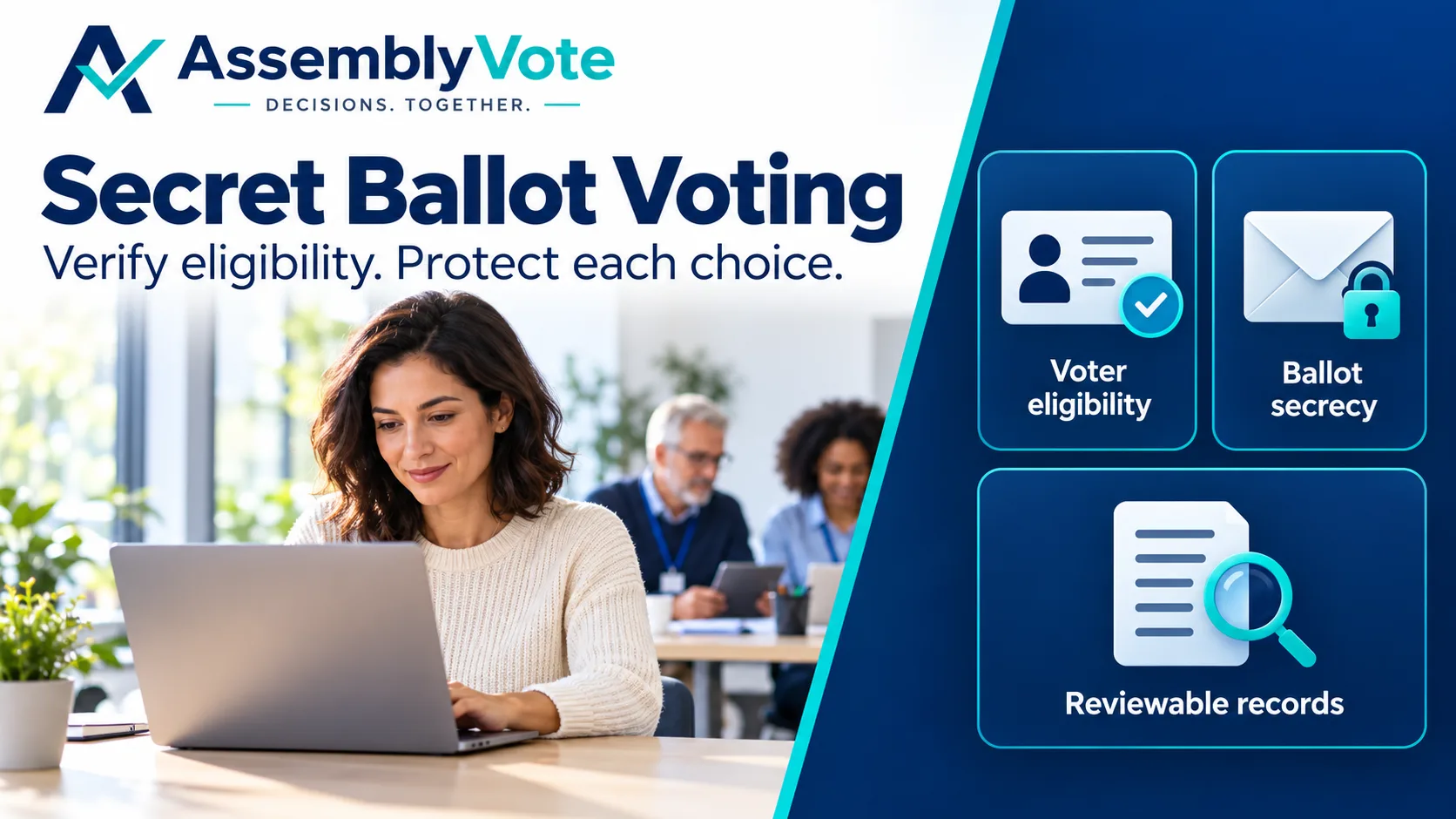
Eligibility answers whether someone may vote in a particular contest. Ballot secrecy concerns whether a person's selection can be linked back to that person by those who must not have that access.
An unrestricted anonymous link may conceal a name while failing to limit participation to eligible members. A named form may validate membership while exposing selections to administrators. Neither design should be assumed to meet your election's requirements without further review.
Ask providers to explain the complete flow from voter authorization to final records in language the election committee can understand.
Ask who can see what
Create a simple access matrix before the demonstration. List voter eligibility, participation status, ballot content, candidate totals, administrator activity, and support records. For each category, identify which roles should have access and when.
Then ask the provider to show the actual permissions in the proposed configuration. Hiding names on a presentation screen is different from preventing an operator from viewing named choices in a report.
Use our nonprofit election planning guide to place those controls in the wider election process.
Test duplicate participation controls
Use a fictional voter to attempt the same election from a second device and after an interrupted session. Ask what event counts as final confirmation and whether an unconfirmed selection is treated differently from a submitted ballot.
Also review the support procedure for lost credentials. A credential replacement or access correction should not silently create an additional voting entitlement. Ask who can authorize the action and how it is recorded.
Your committee should understand the rule even if the provider keeps sensitive implementation details private.
Review identity separation directly
For an election that requires secrecy, ask how the system separates the authorization record from the selection. Request an explanation of what normal administrators, support personnel, and other relevant roles can retrieve.
Ask about exports, logs, backups, and retention as part of the review. A report that omits names is not sufficient evidence if another routine export directly reconnects each person to a ballot.
Do not describe a product as absolutely anonymous or impossible to compromise based solely on a sales presentation. Document the controls demonstrated, the access model, and any assurance evidence your organization requires.
Distinguish participation monitoring from election results
An election committee may need to know how many members have participated so it can manage operations. That does not mean candidate totals should be visible before closure.
Specify the approved result-access policy. Test it using both an ordinary operator and a more privileged role. Decide what information may be shared during voting and keep reminders neutral between candidates.
Ask what a receipt proves
If your process requires a receipt, identify its purpose and permitted content. A confirmation of submission, a record containing selections, and a mechanism for later verification are different designs.
Have the responsible adviser and provider reconcile the receipt requirement with the election's secrecy rules. Do not assume every confirmation email provides the same assurance or belongs in the same workflow.
Review evidence without demanding public ballots
The committee needs a defined way to review participation, authorized actions, incidents, and the final tally. That review should follow the election's confidentiality requirements.
A useful request is: “Show us how an authorized reviewer investigates a disputed participation record without exposing unrelated confidential choices.” This is more concrete than asking whether the system has an audit feature.
AssemblyVote Elections offers configurable secret voting, participation controls, and audit records. Review the product against your required access and verification model.
Frequently asked questions
Does password protection make a ballot secret?
Password protection can control access. Ballot secrecy also depends on how selections are stored, linked, exposed, and reported. Review both aspects.
Is a general poll always unsuitable?
It may suit an informal preference question. For a binding election, evaluate the complete requirements rather than relying on the tool's category or its anonymous setting.
Next step: Discuss your election with AssemblyVote and request a demonstration using a fictional voter, operator, and reviewer.