

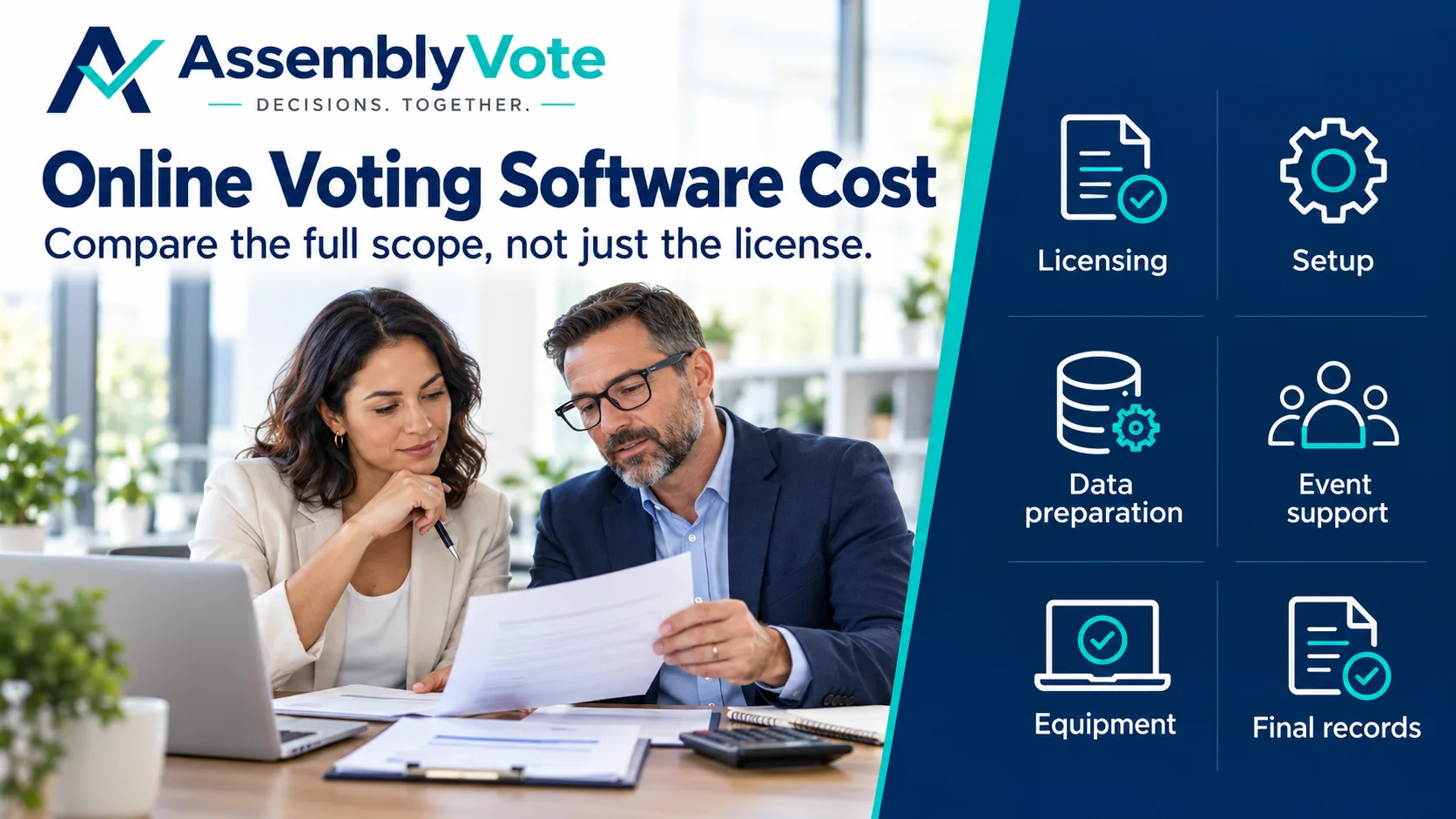
A low license price does not tell an association what its next vote will cost. One proposal may include setup assistance while another expects volunteers to prepare every record. A third may cover the software but leave meeting equipment and support to a separate provider.
To compare online voting software cost, define the event and build a complete budget around the work it requires. Then compare proposals against the same scope.
Describe the event before asking for prices
Specify whether you are conducting a meeting with live motions or a separate election with candidates and a defined voting window. Include the participant count, permitted channels, required records, privacy requirements, and expected support hours.
If an association manages several events, identify their differences. A short board session and a membership-wide candidate election may require different products, preparation, and staffing.
For a wider procurement checklist, see our HOA voting software buyer's guide.
Break the budget into six categories
1. Software licensing
Ask what is counted: eligible voters, registered users, actual participants, events, or a subscription period. Confirm minimums, limits, renewal terms, currency, and applicable taxes.
A per-voter price is not fully comparable until you know whether it uses the eligible roster or only submitted ballots. Record the billing basis beside the amount.
2. Setup and configuration
Identify who creates the event, translates approved rules into settings, prepares contests or agenda items, and checks the final configuration. Ask how many revisions and rehearsals are included.
3. Data preparation
Budget for cleaning the owner or membership list, resolving duplicates, validating voting interests, and approving corrections. Some providers may offer data services, but the organization still needs an authorized source for eligibility decisions.
4. Event support
Define the coverage window, time zone, language, contact method, and tasks included. Distinguish participant access support from running the meeting or interpreting the organization's rules.
5. Equipment and communication
List venue internet, audio, projection, video conferencing, approved notices, printing, and any permitted alternative voting channel. Include an item only when your event actually needs it, and identify who supplies it.
6. Final records and follow-up
Ask about exports, access after closure, retention arrangements, review support, and any additional costs for a recount or special report. Confirm the deliverables in writing.
A fictional cost comparison
The following figures are invented to illustrate the method. They are not AssemblyVote prices or a claim about market averages.
| Budget item | Proposal A | Proposal B |
|---|---|---|
| Software license | $300 | $550 |
| Configuration | $250 | Included |
| Event support | $200 | Included |
| Listed vendor total | $750 | $550 |
| Internal preparation | 6 hours | 3 hours |
If the association uses an illustrative internal planning rate of $30 per hour, the estimated combined cost is $930 for A and $640 for B. The arithmetic is $750 plus $180 and $550 plus $90.
An internal labor estimate is not necessarily an additional cash payment. Volunteer time and paid staff time should be labeled appropriately. The example shows why the license line alone can produce a misleading comparison.
Compare paper and digital methods fairly
For paper, include the relevant notice preparation, printing, postage, handling, counting, and record work. For digital, include setup, assistance, and the remaining offline work required by the approved process.
Do not assume online voting eliminates every paper expense or guarantees savings. A mixed-channel process may retain several costs while adding coordination work. Compare the actual permitted workflows for your association.
Budget for a defined scope change
Ask how the provider prices a larger voter roster, an additional contest, a changed event date, or extended support. Establish an approval process for extra services rather than relying on a vague contingency percentage.
Make sure the board understands which costs are firm, estimated, optional, or excluded before authorizing the purchase.
Request an AssemblyVote proposal
AssemblyVote offers event-based pricing and separately quoted services. Request a scope-specific quote with your participant count, format, and support needs.
Frequently asked questions
What is the cheapest online voting option?
Compare complete proposals against your required controls and workflow. A cheaper license may require more staff work or omit a service your event needs.
Can we compare a meeting quote with an election quote?
Only after clarifying the deliverables. Meeting attendance and live motions differ from a candidate election with its own roster, ballots, and closure process.
Next step: Contact AssemblyVote with one event brief and ask for a proposal that separates included services, optional work, and exclusions.